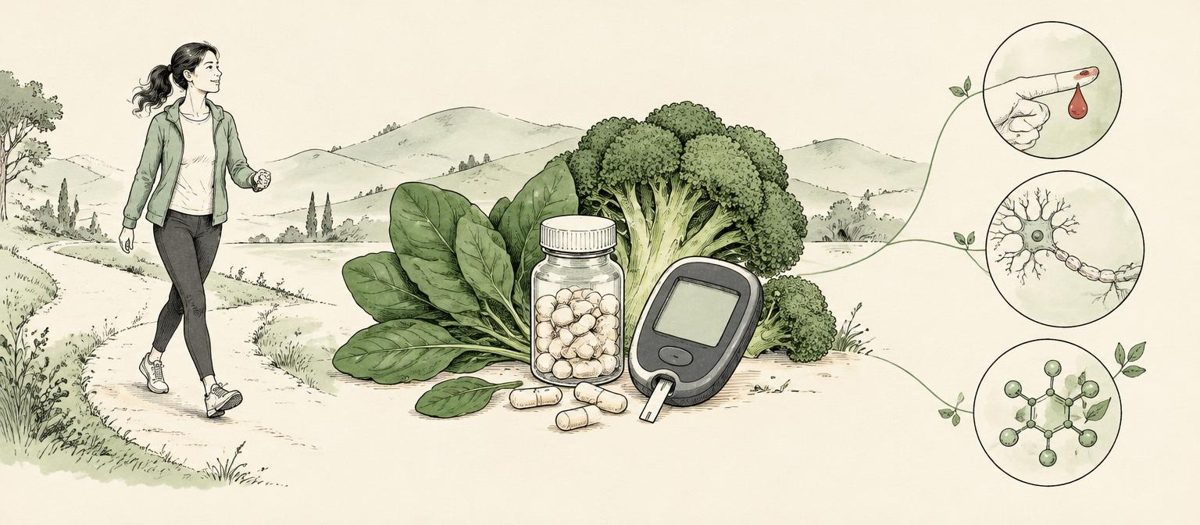
Can alpha-lipoic acid help lower blood sugar?
It may help: blood sugar tended to fall with higher doses in a six-month study of 38 people with type 2 diabetes.
Dr. Brad Stanfield’s article reviews evidence on Alpha-Lipoic Acid (ALA), including that small study. People took either a placebo, a pill without the supplement, or a daily dose. The doses were 300, 600, 900, or 1,200 mg. The study used a mixture of two forms of the supplement.
Both Fasting Blood Glucose and HbA1c (Hemoglobin A1c) tended to drop as doses rose. The first test measures blood sugar after not eating. The second reflects average blood sugar over roughly three months. The source does not give the size of either drop. It also does not establish a clear benefit over placebo.
The article also describes records from 322 people followed over four years. They took 400 to 1,200 mg daily. Fasting Blood Glucose fell only at 800 and 1,200 mg daily. These records show a pattern, but cannot prove the supplement caused it. Lab and animal work suggests it helps cells handle sugar. That does not tell us how much benefit people can expect.
For this community, the useful takeaway is a possible benefit, not a proven dose target. Bloodwork before and during use can help members describe their own patterns. Recording the dose, product form, and dates makes comparisons more useful. Notes about other changes in habits or medicines add context, too. A single lower reading cannot show what caused the change.
What changes, if any, have you seen in your bloodwork while using this supplement?

Comments
No comments yet.